Gamer
Designer
Writer

Graduated High School with a diploma in Computer Science and Maths. Hold a degree in BA Games Design and Art from University of Southampton, part of the Russel Group.
Present-day passions include writing stories and learning about environmental creation.
Business Plan for Creative Industries: A General Plan
The focus of this essay will be the description of a business idea that can fit into the creative industries sector.
The main idea, upon which I would look to create a business would be the ‘gaming industries’. I use the term as such since I am not looking at creating solely video games. I am considering expanding the business into multiple fields that could benefit from the gaming concepts.
IDEA and MARKET
To help define my choice of market, which applies to the idea mentioned before, I brought forward the arguments that follow.
Taking into consideration, that in the UK, the creative industries have seen increasing support from the UK government, comes as no surprise, as between 1997 and 2014 the GVA has seen an increase of 6% each year, compared to the standard 4,3% from the other industries, providing almost £10m/hour.
Considering the above, as well as the fact that the IT, Software and Games market lead the industry, I believe that this market, whilst large, still presents the best opportunity for development, as it goes hand in hand with the evolution of technology itself, and by being in the creative industries, has financial help from the government.
Besides leaning on the game market, another market that can be approached is the gamification market. Gamification can be defined as the inclusion of game design techniques and mechanics to tap into the emotive part of people, by engaging them and motivating them, with achievements and statuses, to help them reach their goals (Gamification, no date).
As such the main idea of my business is to rely on game development contracts, be it direct creation of own games, or subsidiary contracts, in developing for other companies, to ensure the main income, while considering projects with companies from different industries, as to develop applications that rely on the usage of game development techniques, as to attract their clients towards their product.
In accordance with my idea, the markets that I am aiming for are: the gaming market, concentrating on indie game development as well as game development contracts, and the gamification market.
Business Set-Up
Before focusing on a product or service the company would need to be first set up.
The type of company that would be set up is a Limited Company. A limited company is an organisation that has full responsibility for what it does and financially is kept separate from any personal finances. The profits that it makes, after paying the Corporation Tax are it's own and is then shared between the hired people and the ones that share the company (Choose a legal structure for your business, 2016).
I believe that this would be the best type of company to start as it provides good financial backing to start with, while also providing a low risk for investors, as in case of bankruptcy. The company should also start as private, as it does not have a minimum capital to share between the investors and it can be run from an own house, to start with. The disadvantage is that discussions may appear between the director and shareholders as to what is best for the company, but I believe that with proper meetings this can be resolved (Adrian, 2010).
Looking at the facts previously mentioned, the best set up would be that of a private limited company, because of the financial security, a starting fund, which is shared between investors and low requirements of start-up, like own home.
Design of the product and services
As the market that the business is aiming for is quite a wide one, taking into consideration that it will not focus just on video games, the design process will need to be carefully thought of, to bring something unique. That should also be considered for software that is to be made for different companies.
As such, a definition between the design of the product and the design of the services should be considered.
Therefore, product design is defined as a combination between ergonomics and product and business knowledge to produce concepts and ideas, which can afterwards be converted into usable objects or services. Service design represents an activity that consists of the organisation and planning of people, communication and material components to improve the quality of services (Operations management - Ch. 4 product and service design, no date).
What should also be mentioned is the difference between the service and the product, which is the following: services are intangible and are mostly made and given at the same time, while products are tangible and can be held in inventory. Also, the best services are usually the most visible to customers (Operations management - Ch. 4 product and service design, no date).
The products that will be made, will go through the 4 stages during the production: introduction or research, growth or sustainability, maturity or steady demand and decline or discontinuation (Operations management - Ch. 4 product and service design, no date).
Contemplating on the above definitions, the services that the business will provide are those of game and software development, be it self-made or subcontracted, and to be able to provide a good service communication with the clients, will need to be constant.
Hence, in each design of the product, be it a game of any kind or software, proper research must always be conducted, to analyse the market and to be sure that the design will not copy what is already done, or if it does, it improves it substantially.
Another factor is the audience for which the product designed is for. In this case, the individual games or software developed have a direct audience, the players or users that must be thought of. In the games that are subcontracted to help create, the importance of the audience, takes a second role to the goals set out by the main company. In the case of gamification software for companies, the audience is already set by the company, so the goals have the main role.
Something else that goes into the design of a product is the influence from the outside, as nowadays the design, especially those of games, are no longer set on a predefined path, and must always be under constant development, as it adjusts to the requirements of the audience. Reflecting on the aforesaid, another matter which must be considered is communication with the audience of the product or service. So, a proper service must be used to assure a proper way of giving and receiving information when designing such as Twitter, Facebook, Blogs.
Reflecting upon the above, what must be taken into consideration for designing a product is proper research, the audience for it and the communication with it. As to what concerns the service, I believe that a proper line of communication with the users, will allow a proper development of the product.
Materials/Resources
In terms of creation, a product or even a service, cannot be achieved without the proper materials or resources available.
First and foremost, for every good business a location is necessary. While at the start a home location is convenient, with the business expanding, a proper housing for it is required. As such one should be found as to allow a proper studio environment, which allows communication between the designers and programmers, as to encourage a proper flow of ideas and to improve chemistry, leading therefore to a better product.
After a location is found, proper equipment is necessary, thus equipping it, in this case, with computers provides a beginning of operations. Leftover space can be used by the artist and designers to make themselves a familiar workplace. On further development and request more equipment can be provided.
Upon having the required equipment, the basic programs for game development are necessary. Those can be, depending on what you need: Unity, GameMaker, CryENGINE, Microsoft Visual Studio, Notepad++, Sublime Text 2, Blender, Audacity, Trello (Bankhead, 2014).
Besides the aforementioned, there are a lot of other programs and suites that can be obtained, depending on the choice of the artist. However, a standardized usage should be made, as to allow programs and games to be as effective as possible.
Upon having the required resources, a starting platform is needed as to launch the projects that are to be made. To start with, crowdfunding would be the best option, as it gives a direct interaction with the people the game or program is being made for. Alternatively, another option is subcontracting, from other companies as to allow the business to gain clients, as well as experience in the field. As to what concerns subcontracts, those can only be achieved after rigorous meetings with the firms that require developers or studios to subcontract, and as such, in the beginning the market is quite small.
In regards with crowdfunding, besides helping achieve a fund for a self-made game, the interaction with the audience also helps in better designing the product. In terms of crowdfunding platforms, there are no shortage of them, with Kickstarter and Indiegogo, leading them, but those such as Patreon, RocketHub and others provide alternatives, depending on what is needed to create (Floship, 2016).
Looking at the above, the necessary resources and materials needed are the following: a location, equipment, programs and a proper funding platform.
Marketing
While having the materials and resources needed to create the product, or even if the product is finished, it cannot sell itself. That is why a good PR and marketing campaign is necessary.
First and foremost, before thinking about the strategy, a delimitation between the two must be made. Hence, marketing, in quintessence, means the manipulation of consumers to persuade them to think, believe or do what is wanted of them. On the other hand, public relation concerns itself on influencing the reputation of a person or a business (Wakeman, 2007).
As the main purpose of the business is indie games and software production, the marketing is somewhat similar, and as such, the following marketing strategy and PR plan is made for an indie software.
1 – Goals
First and foremost, the goal should be the one that at least breaks even with the production costs. Afterwards goals should be added for sales, downloads, conversion rate and price.
Conversion rate identifies itself as the number of players that buy the game. For example, if 1 out of 100 players buys the game, then the conversion would be 1%. The conversion rate relates itself to the download number, as well as the sales and price as such: if the general goal is to get £1000 and the price is £10, then you should have around 100 sales. That means that, per the conversion rate, you would need 10.000 downloads, to reach the cost target. Therefore, it is important to calculate all this goals, as mentioned before, to at least break even with the production cost, after the cost spent on publishers/distributors and eCommerce provider.
2 – Distribution
After the goals, have been set, a proper distribution channel should be established. The several options that are available can be retail stores, portals, publisher channels, but also website stores. Some of the more known portals are Big Fish Games, EA`s Pogo, Yahoo Games, although there are several others. One of the bigger publishers of indie games that provide a possibility is PopCap. The most probable channel would be however the most known content delivery system, which is Steam.
In terms of software created either as an Indie Project or gamification contract, they can be distributed through known platforms such as GitHub, Google Code, LaunchPad or SourceForge, these being only some of the possible options (Where do I publish a program?, 2017).
3 – Product
After setting up the distribution channel, it is best that the product is at a stage at which it can be played or used. This stage is the point at which some closed feedback is best, as to further refine it, until release time.
4 – Promotion
The next step in the marketing strategy is the promotion of your product. This can be done via multiple ways. For example: promotional materials (trailer videos, screenshots, press releases, landing page, development blog), articles in top-tier publications and maintaining a fanbase.
Thinking about the aforesaid, the promotional material should always be top quality, no matter which one is it. The articles can only be obtained through direct contact, and a thank you letter for those that publish them is always a must, as well as contact over time, in order to maintain a good relationship with the media. As to what concerns the maintenance of the fanbase, that can be done by maintaining regular appearances at game jams and other events, posting daily on social media, activity on forums and blogs, and everything else that pertains to these types of activity (Jonassen, 2013).
5 – Website
This is the place that is at the forefront of the game. It has the role of convincing visitors to download the demo of the game. A proper configuration must be made, as the demo needs to be easily downloadable and to be sure that the purchase page is easy to access. The format also needs to be attractive as to raise the curiosity of the people.
6 – Demo
The demo must be made in such a way, that it becomes an incentive to make the player purchase the game. As such the demo, should have limited features or a limited trial and have an easy guide for the purchase.
7 – Measurement
To be sure that sales are going accordingly, a constant presence should be achieved as to measure the effects that take place for promotional sales, a change of price, a modification of the demo and such.
8 – Maintenance
At this step, there will be a continuous relation with the clients, as to provide support in any problems or bugs they may find, either in the software or the process to acquire it, or general questions.
9 – Refinement
This is the final step, were the only thing remaining to do is either promote the product more, or refine it a bit, depending on the feedback gained or conversion rate. Eventually this will become the step on which the product will need to be shut down (Hietalahti, 2006).
Taking the above in consideration, it can be said that a good marketing and PR campaign consist of set goals, proper promotion of the software and constant connection with the customers and refinement.
Logo
Every business must have something that must instantly make it recognizable. And as such, the design of the logo, for my business, must have something to relate it to the domain it works in, a title, and a catching phrase. Therefore, I decided for the logos found in the gallery.
Positioning and Branding
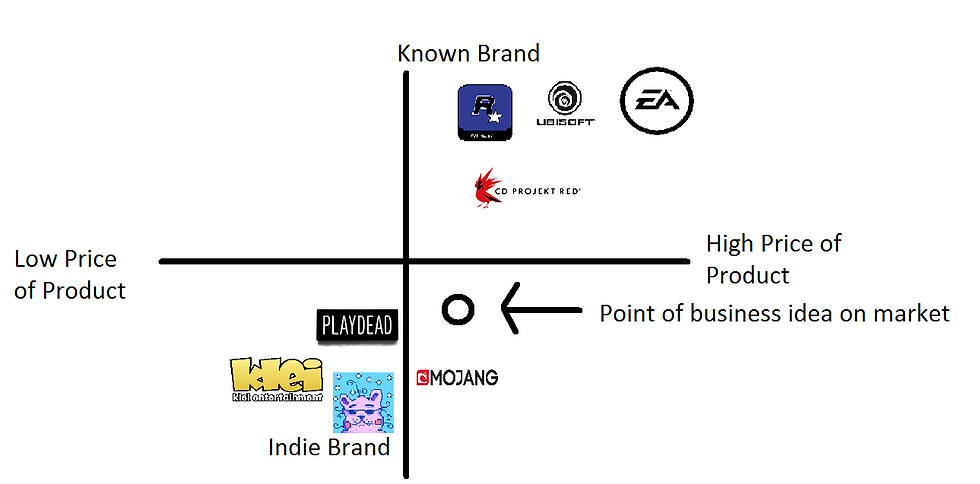
Before setting the brand in the market, first, there should be a differentiation between the positioning and the brand itself. Hence, branding can be defined as the personality of the product, be it high cost or low cost, while positioning pertains to the reputation of the said brand (Richards, 2017).
Taking into consideration the above the position of the brand would be in an above average indie market. The figure can be seen in the gallery.
Conclusion
It can be said that my business idea is that of a company that will focus on gaming and software development and in doing so, it will aim to have a close relation with the audience and to provide good and affordable products for the masses.
References
Adrian (2010) Advantages and disadvantages of a limited company - TheCompanyWarehouse Blog. Available at: https://www.thecompanywarehouse.co.uk/blog/2010/02/03/advantages-and-disadvantages-of-a-limited-company/ (Accessed: 9 January 2017).
Bankhead, J. (2014) Recommended resources: Game development. Available at: https://gamedevelopment.tutsplus.com/articles/recommended-resources-game-development--cms-55 (Accessed: 9 January 2017).
Choose a legal structure for your business (2016) Available at: https://www.gov.uk/business-legal-structures/limited-company (Accessed: 9 January 2017).
Creative Industries (2014) Creative industries add £84bn to UK economy. Available at: http://www.thecreativeindustries.co.uk/uk-creative-overview/news-and-views/news-creative-industries-add-%C2%A384bn-to-uk-economy (Accessed: 9 January 2017).
Floship (2016) 13 best Kickstarter alternatives to Crowdfund anything. Available at: https://www.floship.com/kickstarter-alternatives-you-should-know-about/ (Accessed: 9 January 2017).
Free logo maker & logo design | make a logo online, try it free! (2017) Available at: https://www.freelogoservices.com/step1 (Accessed: 9 January 2017).
Gamification (no date) Available at: https://badgeville.com/wiki/Gamification (Accessed: 9 January 2017).
Hietalahti, J. (2006) The basic marketing plan for Indie games. Available at: http://www.gamasutra.com/view/feature/2695/the_basic_marketing_plan_for_indie_.php?print=1 (Accessed: 9 January 2017).
Holdings, M. (2017) The difference between marketing, PR, advertising and Branding. Available at: http://adsoftheworld.com/blog/ivan/2007/apr/11/the_difference_between_marketing_pr_advertising_and_branding (Accessed: 9 January 2017).
Jonassen, E. (2013) Konsoll 2013 [SLIDES]. Available at: http://www.indiegamegirl.com/konsoll-2013/ (Accessed: 9 January 2017).
Operations management - Ch. 4 product and service design (no date) Available at: https://ids355.wikispaces.com/Ch.+4+Product+and+Service+Design (Accessed: 9 January 2017).
Richards, L. (2017) ‘What is the difference between Branding & positioning?’, Small Business Chron.
Wakeman, S. (2007) Simon Wakeman. Available at: http://www.simonwakeman.com/blog/2007/04/24/whats-the-difference-between-marketing-and-public-relations/ (Accessed: 9 January 2017).
Where do I publish a program? (2017) Available at: http://softwareengineering.stackexchange.com/questions/33028/where-do-i-publish-a-program (Accessed: 9 January 2017).